Home / Stress & Nervous System Wearables / Pulsetto
Stress & Nervous System Wearables
Pulsetto
A neck-worn transcutaneous vagus nerve stimulation (tVNS) wearable from a real, named Lithuanian health-tech company — genuine, if early, supporting research and an unusually honest set of company disclaimers, alongside a well-documented billing pattern on the brand's own checkout that's worth knowing before you buy.
Neck-Worn tVNS$269 MSRPNot FDA-Cleared
Pulsetto is a different kind of listing for this site: a real, identifiable company selling a real device, not an anonymous drop-shipped gadget. We're holding it to that higher bar — checking the evidence, the regulatory status, and the complaint record — rather than assuming it belongs in our usual "flagged" bucket.
We link to authorized retailers and may earn a commission at no extra cost to you
What we found
CompanyPulsetto — Vilnius, Lithuania, founded 2021
Regulatory statusNot FDA-cleared — sold as a general wellness device
Independent evidenceReal but mixed at the category level; Pulsetto's own data is self-funded and exploratory
Checkout complaint recordBBB rating F; recurring subscription-billing theme on Trustpilot
Why we point you to Amazon instead
The device itself isn't the problem we found — the documented pattern of surprise app-subscription charges tied to Pulsetto's own direct checkout is (details below). Buying through Amazon gets you the same device without opting into that specific checkout flow.
Clicking "See it on Amazon" opens a live Amazon search for this exact product — not a specific listing we control — so you can compare current sellers, prices and reviews yourself before buying.
See it on Amazon →As an Amazon Associate, we earn from qualifying purchases.
What Pulsetto actually is
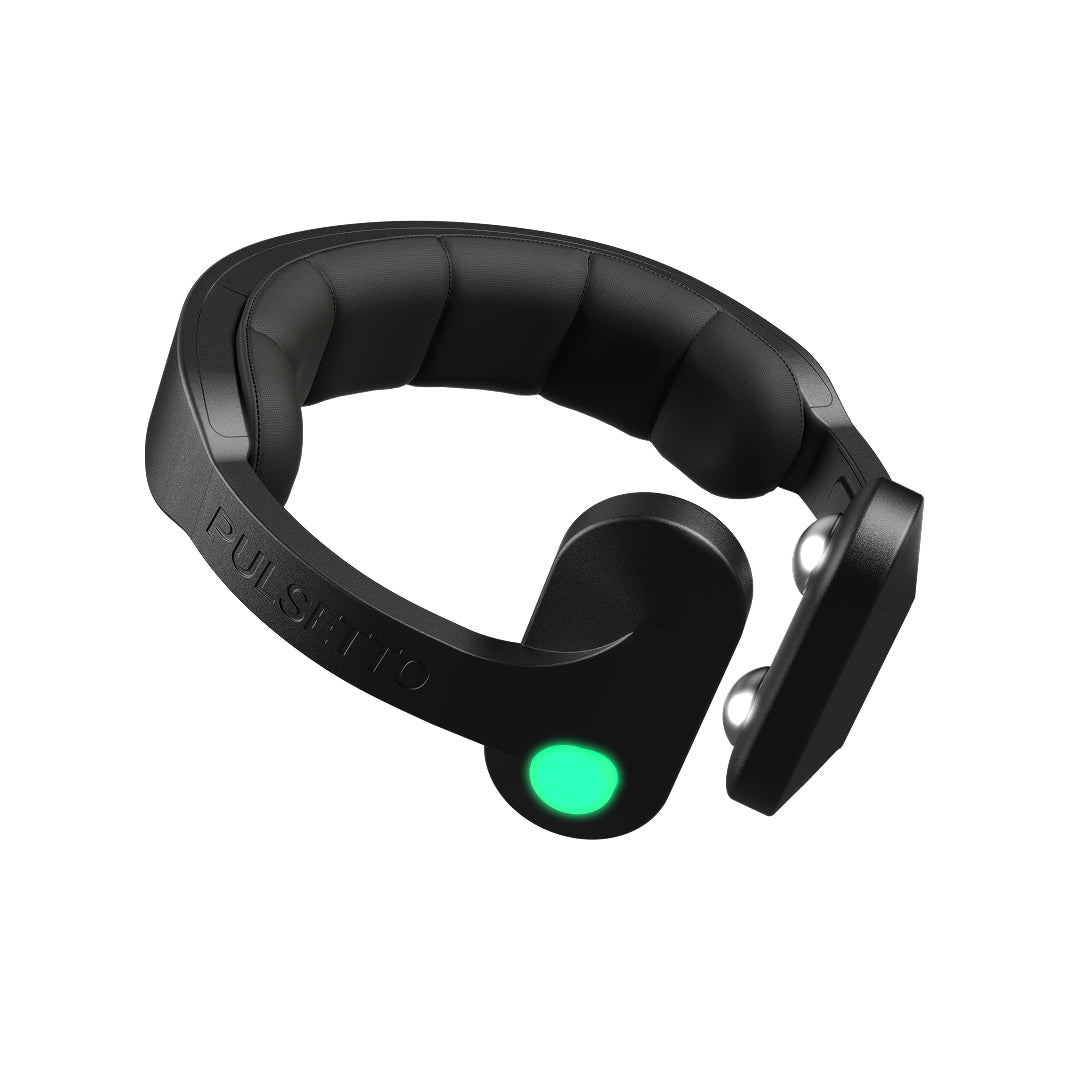
Pulsetto is a Bluetooth-connected, neck-worn device made by Pulsetto, a health-tech company headquartered in Vilnius, Lithuania, founded in 2021 by Povilas Sabaliauskas and Vitalijus Majorovas and manufactured in Lithuania. The device sits against both sides of the neck and delivers mild electrical pulses — reported at roughly a 4,500–5,200Hz carrier frequency with a 25Hz pulse-repetition rate — to the skin near the vagus nerve, using a conductivity gel and a companion smartphone app to select a program (stress, sleep, burnout, and pain modes are listed) and control session length, typically several minutes at a time. It's sold in two versions, Pulsetto FIT and Pulsetto Lite, and is available both through the company's own site and through third-party retailers, including Amazon.
The evidence — real, but early, and mostly self-funded
The broader science on vagus nerve stimulation is real, and genuinely mixed
Non-invasive vagus nerve stimulation is an active, legitimate area of research. Peer-reviewed studies from 2024–2025 have reported some positive signals — a double-blind randomized trial found effects on anxiety and pain perception, and a 2025 open-label pilot (the iWAVE trial) explored feasibility for inpatient depression and anxiety. But the picture isn't uniformly positive: a separate 2025 study specifically found that transcutaneous auricular stimulation did not measurably change physiological or psychological responses to an acute stressor. Most of this published research targets stimulation through the ear (auricular), not the neck (cervical) placement Pulsetto uses — a real, meaningful distinction, since the two approaches aren't automatically interchangeable just because both target the vagus nerve.
Pulsetto's own numbers, and the honest fine print underneath them
Pulsetto's own marketing cites pilot results — roughly a 45% reduction on a standard anxiety scale (GAD-7) and a 41% reduction in sleep disturbance (Pittsburgh Sleep Quality Index) after four weeks, plus a cortisol reduction in a majority of participants measured via hair biomarker testing. To the company's credit, its own product page discloses the real limits of that data in plain language: "Exploratory pilot data (n=40), no placebo control" and "Results may vary." That's a materially more honest disclosure than most products we review in this category make about their own evidence — but it also means there's no independent, peer-reviewed, placebo-controlled trial behind these specific numbers, only the company's own small internal study. Pulsetto's website also lists a real slate of external studies in progress or planned for 2026 across conditions like migraine, insomnia, and long COVID — none completed or published as of this review.
Regulatory status, stated plainly
Pulsetto is not FDA-cleared for any medical condition. The company's own disclaimer describes it as a general wellness product that is not a medical device and is not intended for diagnosing or treating any disease or medical condition. That's a real, meaningful difference from a device like electroCore's gammaCore — an FDA-cleared, prescription-only vagus nerve stimulator indicated specifically for migraine and cluster headache — which we mention only for regulatory contrast, not to suggest the two products are equivalent or interchangeable. If you're looking at Pulsetto to help manage a diagnosed medical condition rather than as a general wellness tool, that distinction matters, and talking to a doctor first is the more appropriate path than relying on a general-wellness device.
What we found
A real, named company — not an anonymous storefront
Unlike most products in our "flagged" bucket, Pulsetto isn't hiding behind a faceless order page. It's a real, venture-backed Lithuanian company with named founders, a Vilnius headquarters, and its own published (if company-funded) research roadmap. That's a meaningfully different risk profile from a product with no verifiable manufacturer at all.
The real cost adds up past the $269 sticker price
The Pulsetto FIT lists at $269 (against a stated $619 regular price — a permanent-seeming discount structure that's a common marketing pattern across direct-to-consumer wellness brands, not a one-time deal). Ongoing conductivity gel runs roughly $11–$102 a year depending on where you source it, and the app's Premium tier is an optional $129/year after an included 14-day trial. One buyer's published account of their purchase also describes discovering, after the fact, that the box didn't include a wall charger — only a USB cable — with Pulsetto's own $20 charger sold separately.
A well-documented billing and subscription complaint pattern
Pulsetto's BBB profile (Westerville, OH) carries an F rating, is not BBB-accredited, and shows 35 complaints on file, 23 of them unanswered by the business — with a stated pattern of subscription-billing disputes and difficulty getting refunds honored. A separate BBB filing under "Pulsetto LLC" (Superior, CO) adds 7 more complaints over three years, also unanswered, describing billing, order, and product-return problems. On Trustpilot, Pulsetto holds a 4.2-star average across roughly 3,447 reviews (62% five-star) — a genuinely decent aggregate score — but the negative slice (16% one-star) repeats the same theme: customers report being charged for the Premium app subscription without clear consent, sometimes continuing after a stated cancellation. A first-hand buyer account we reviewed described the 14-day Premium trial starting at the moment of purchase rather than at delivery — meaning a roughly two-week shipping delay left the buyer with only hours of actual trial time before a $49.17 charge posted.
Why this isn't a "flagged" listing: we found no evidence of a fake manufacturer, undisclosed ingredients, deepfake endorsements, or fabricated backstory here — the concerns above are specifically about the direct-checkout billing flow, not the legitimacy of the company or the device. That's why we're pointing you to buy the same device through Amazon rather than warning you off it entirely.
Who this is (and isn't) right for
Worth considering if...
You're interested in trying vagus nerve stimulation as a general relaxation tool, you've read the honest limits of the company's own pilot data above and are comfortable with early-stage, self-funded evidence, and you'd rather buy through Amazon than opt into Pulsetto's own subscription-trial checkout flow.
Not the right fit if...
You're looking for a device to manage a diagnosed medical condition (talk to a doctor and consider FDA-cleared options for that), you want a large, independent, peer-reviewed evidence base before spending $269+, or you're not comfortable with a category where even the honest version of the evidence is a single unblinded company pilot study.
Frequently asked questions
Is Pulsetto FDA-cleared?
No. Pulsetto is sold as a general wellness device. The company's own disclaimer describes it as not a medical device and not intended for diagnosing or treating any disease or medical condition.
Does the evidence show vagus nerve stimulation actually works?
The broader research on non-invasive vagus nerve stimulation is real and includes some genuinely positive peer-reviewed findings on anxiety and pain, alongside at least one 2025 study that found no measurable effect on an acute stressor. Most of that published research targets ear-based stimulation rather than the neck-based approach Pulsetto uses. Pulsetto's own supporting numbers come from a single company-funded pilot study of 40 people with no placebo control — a real starting point, honestly disclosed by the company itself, but not yet the kind of independent, controlled evidence that would let us call the effect settled.
Is Pulsetto a scam?
No — we don't think that label fits here. It's a real, named company selling a real device with an unusually candid set of disclaimers about its own evidence. The genuine concern we found is narrower and specific: a documented pattern of customers being billed for an app subscription they didn't clearly consent to, tied to the brand's own direct checkout. That's why our recommendation is to buy the same device through Amazon rather than to avoid the product altogether.
Why do you link to Amazon instead of Pulsetto's own site?
Buying through Amazon gets you the same physical device without going through the checkout flow where the subscription-trial billing complaints above originate. It's not a statement that the device doesn't work — it's a narrower, practical way to avoid a specific, well-documented checkout issue.
Sources
Sources: Pulsetto's own product page and "Ongoing Studies and Trials" page (pulsetto.tech); Innerbody.com's Pulsetto review (device specs, pricing, FDA status); a first-hand buyer account published on Ibisik.com (purchase experience, billing, missing charger); Better Business Bureau business profiles for Pulsetto (Westerville, OH) and Pulsetto LLC (Superior, CO); Trustpilot's aggregate rating and review data for pulsetto.tech; peer-reviewed research on transcutaneous vagus nerve stimulation published via Frontiers in Integrative Neuroscience (2024), ScienceDirect/Neuromodulation (iWAVE pilot trial, 2025), and PMC (2025 study on taVNS and acute stress response); company background on Pulsetto's founding, headquarters, and manufacturing location.
Early Wellness Radar is operated by Digital Media Innovations, LLC. 11650 Miracle Hills Drive, 4th Floor, Omaha, NE 68154, United States · [email protected]
Product specifications and manufacturer claims are as disclosed by each manufacturer. Results and product performance may vary.
We use cookies for essential site function and, with your consent, for advertising measurement via Microsoft Advertising. See our Cookie Policy for details, or manage your choice anytime.