

A twice-daily capsule marketed for sharper visual detail, reduced blue-light strain, and better night and central vision — sold almost entirely through the brand's own direct-to-consumer order pages rather than general retail.
We were not able to independently test this product ourselves — and as documented below, we couldn't even confirm a single consistent ingredient list for it. What follows is sourced from the brand's own competing order pages and public reporting, not our own lab testing.
We link to authorized retailers and may earn a commission at no extra cost to youOptivell is sold as a capsule supplement — two capsules a day — marketed to "sharpen visual detail," "shield eyes from blue light," and "boost night and central vision." A single one-month bottle (30 capsules) is listed at $49 through the brand's own order pages, with 3-bottle and 6-bottle package options advertised at a "72% discount" and up to "$780" in total savings, on top of a money-back guarantee. Some versions of the marketing build the pitch around a specific named "protocol" story rather than presenting the product as a plain daily vitamin — addressed further down.
We found Optivell sold as the "official" product on optivell.org, optivell.net, optivell.co, optiwell.us, optivell-us.com, optivell-max.com, and mingwang-official.site — plus optivell.us, which no longer resolved by the time we checked it during this research. optivell.org's own page lists 13 ingredients — Taurine, Alpha Lipoic Acid, Vitamin C, Vitamin A, Bilberry, Quercetin, Lycopene, Lutein, Zeaxanthin, Astaxanthin, Ginkgo biloba, Rutin, and Saffron — with no individual amounts disclosed. optivell.net, styled the same way as an official Optivell order page, lists only 6 ingredients: Vitamin A, Lutein, Zeaxanthin, Bilberry Extract, Zinc, and Vitamin C — also with no doses shown. Two sites both presenting themselves as the one real Optivell disagree, in writing, on more than half of what's supposedly in the bottle.
Both order pages we reviewed describe the product only as made "in the United States in a state-of-the-art FDA registered and GMP certified facility" — no company name, no street address, nothing we could use to verify that claim independently. Paired with the undisclosed ingredient amounts above, that means we couldn't find a real supplement-facts panel anywhere that would let a buyer compare this product's actual dosing against the published research on any of its named ingredients.
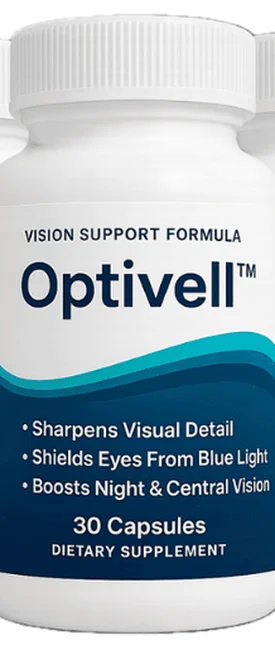
The single image optivell.org uses as its product photo — we counted it reused seven separate times across the page's hero, benefits, ingredients, and final order sections — isn't a plain bottle shot. It's a side-by-side comparison graphic: bottles labeled "Optivell" sit under a red "Old Version ✗ 59% Accurate," next to bottles from a completely different, differently branded product ("VisiVra") marked with a green "New Version ✓ 99.9% Accurate." We downloaded and viewed the file directly to confirm this. A separate image used on the same page as the 60-day money-back guarantee badge is saved on the server under a filename referencing "VitaHearPlus" — an unrelated hearing-health product — consistent with a mass-produced order-page template being reused across different "brands" without even renaming the leftover image files. We couldn't find a single trustworthy, unedited photo of the actual product on any of the sites we checked, so the bottle shot at the top of this page is our own crop of that same comparison graphic — just the "Optivell" bottles, with the misleading "Old Version"/"New Version"/accuracy-percentage claims and the competing "VisiVra" bottles cropped out — shown so you can see what the physical bottle actually looks like without repeating the vendor's own bait-and-switch framing.
optivell.org displays a 60-day money-back guarantee badge. optivell.net — also presenting itself as Optivell's official order page — advertises that same 60-day window on its main page, but a separate FAQ section on that same site references a "90-Day money-back guarantee" instead. We couldn't find anything on either site reconciling which window actually applies once you've paid.
Dr. Ming Wang, MD, PhD — a real, practicing ophthalmologist and founder of Nashville's Wang Vision Institute — posted directly to his own official Facebook and LinkedIn accounts that an AI-generated advertisement is circulating online using his likeness and background, without his involvement, to promote "eyesight-restoring supplements" built around a "frozen berry"-style ritual. Dr. Wang's own statement doesn't name Optivell specifically. Separately, though, independent reviewers who looked into Optivell's own marketing — including a dedicated writeup at StreetsofKante.com and several "scam or legit" video breakdowns — describe this same deepfake and its "Frozen Berry Protocol" narrative as the ad campaign used to sell Optivell, and note the identical deepfake footage has also been reused to sell a separately branded product ("OptiVision"). We're keeping the confirmed part (a real doctor's real, public denial of a faked endorsement in this niche) separate from the part we could only source secondhand (the specific tie to Optivell's own funnel) rather than blending the two together.
The Better Business Bureau's Scam Tracker has a report, filed March 12, 2026, describing a purchase of six bottles of Optivell made through a Facebook ad on February 23, 2026, for $299.15. The buyer wrote that the product was advertised to "sharpen visual detail, boost night and central vision, shields eyes from blue light" — language that matches Optivell's own marketing almost word for word — and reported no results after taking it daily. When the buyer tried to return it, the phone number printed on the shipping package turned out to belong to an unrelated insurance and medical-alert company, and the customer-service line listed for returns was disconnected.
We didn't find independent clinical evidence for this specific formula, and — as covered above — we couldn't even pin down one consistent ingredient list for it across the brand's own websites. Several named ingredients (lutein, zeaxanthin, and bilberry, for example) do show up in eye-health research generally, but at what dose, and in which of the two conflicting formulas, isn't something Optivell's own marketing discloses. Anyone with a diagnosed eye condition should talk to an eye doctor rather than treat a supplement like this as a substitute for care.
We can't tell you that with confidence, and we don't think you should have to guess. We found at least eight domains presenting themselves as Optivell's "official" site, one of which had already stopped resolving by the time we checked it, and two of the others disagree on the product's own ingredient list. If you're trying to match an ad you saw to a specific site, check the exact domain in your browser's address bar against your order confirmation email before entering any payment details.
We're not going to put a one-word label on it — here's what's documented, and you can weigh it yourself. Multiple sites calling themselves the official Optivell page disagree on the ingredients; none discloses a manufacturer name, address, or per-ingredient dose; the guarantee window is stated two different ways across those same sites; the product's own main marketing image brands "Optivell" bottles as the inferior version being replaced by a different product; a real ophthalmologist has publicly denied any connection to a deepfake-style ad pattern documented in this exact product category; and a dated Better Business Bureau report describes a buyer losing $299.15 through a return process that led to a disconnected phone number. That's the record as we found it.
Sources: Optivell order pages at optivell.org and optivell.net, fetched and reviewed directly for ingredient lists, pricing, guarantee terms, and product imagery; the Better Business Bureau's Scam Tracker report #1220497, filed March 12, 2026; Dr. Ming Wang's official Facebook and LinkedIn statements regarding an AI-generated deepfake advertisement using his likeness; StreetsofKante.com's investigative coverage of Optivell's "Frozen Berry Protocol" marketing and the related "OptiVision" deepfake ad; Trustpilot's listing for myoptivell.com, which showed zero reviews on file at the time of this research.
We can't recommend Optivell given what's above. If what you're actually after is a well-established, transparently dosed eye-health formula, here's a real option: PreserVision AREDS 2 Eye Vitamin & Mineral Supplement (Bausch + Lomb).
What it actually is: a softgel supplement that prints its full formula on the label — lutein, zeaxanthin, vitamin C, vitamin E, zinc, and copper — built on the dosing used in the National Eye Institute's own AREDS2 clinical trial on age-related eye health.
Why we mention it instead: it's sold under a named, accountable manufacturer through normal retail, with every ingredient amount printed on the label rather than folded into an undisclosed proprietary blend, and it isn't sold through a rotating set of lookalike order pages. It's positioned for general macular and eye-health support, not a direct claim to reverse vision loss — a more honest framing for what a supplement can actually be expected to do.
Clicking "See it on Amazon" opens this specific listing on Amazon — not a page we control — so you can check the current price, seller, and reviews yourself before buying.
See it on Amazon → As an Amazon Associate, we earn from qualifying purchases.We measure the claims. You see the readout.